
AI Data Center Tax Breaks: What Taxpayers Are Covering
The AI boom runs on taxpayer money. The Big Beautiful Bill handed the biggest breaks to the biggest companies, and a new Congress could take them away. That's why AI stocks are panicking.
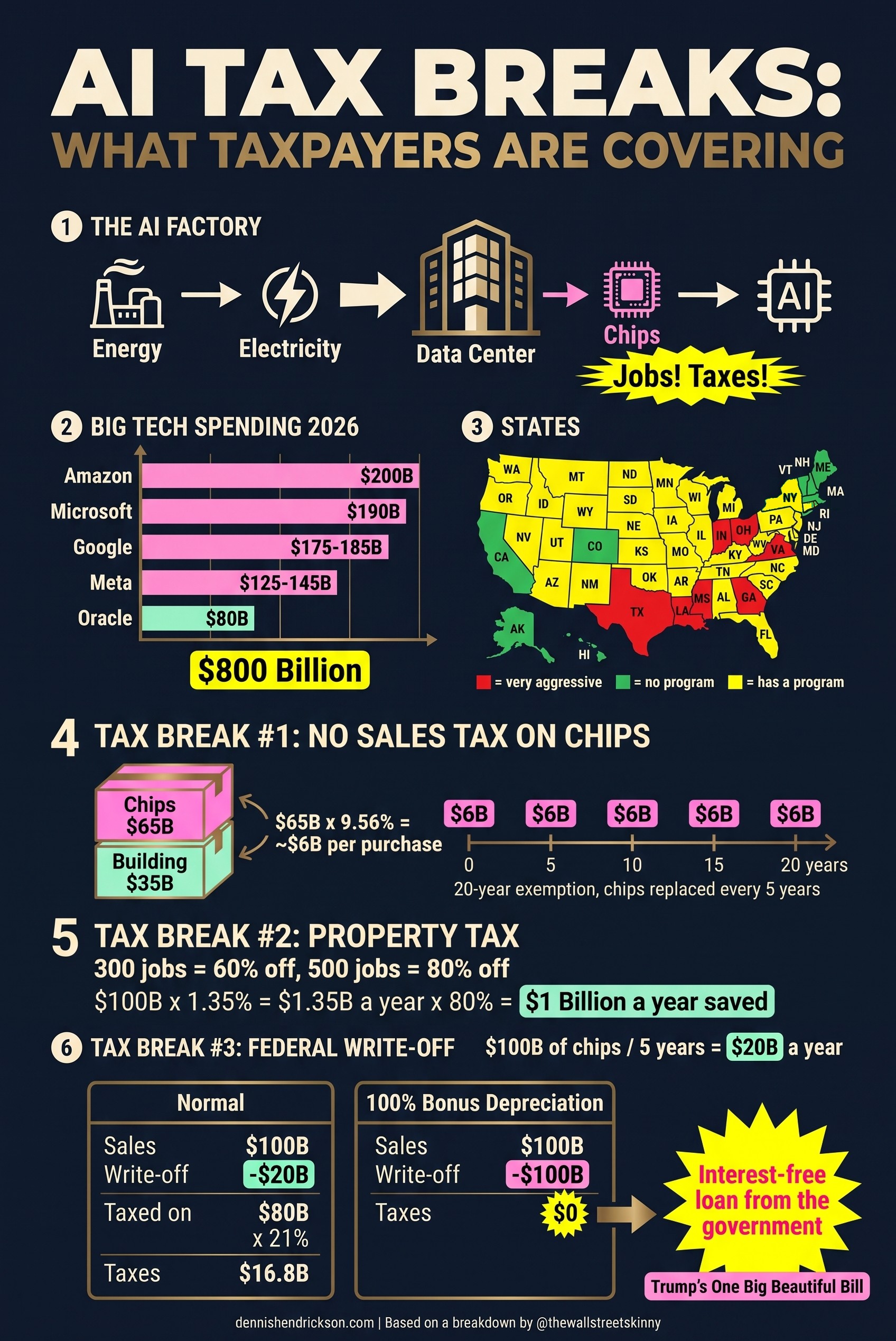
AI data center tax breaks are a big part of how the AI boom pays for itself. The companies get three of them: no sales tax on their chips, a huge discount on property tax, and a federal rule that lets them wipe out their tax bill the first year. Take those away and the math on these AI factories looks a lot worse. That is exactly what Wall Street is afraid of now that Democrats have won Congress. Here is how it works, one picture at a time, based on a breakdown by @thewallstreetskinny, a former Morgan Stanley banker.
1. What an AI Data Center Is
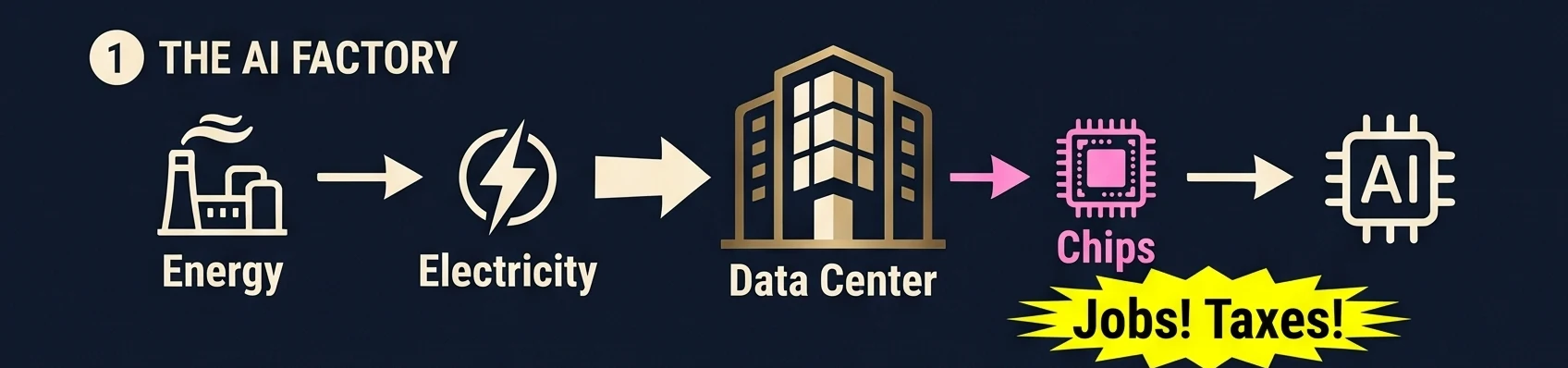
Think of a data center as a factory. A power plant makes energy. It comes in as electricity. The building is full of computer chips, and the chips are the expensive part. What comes out is the AI you use.
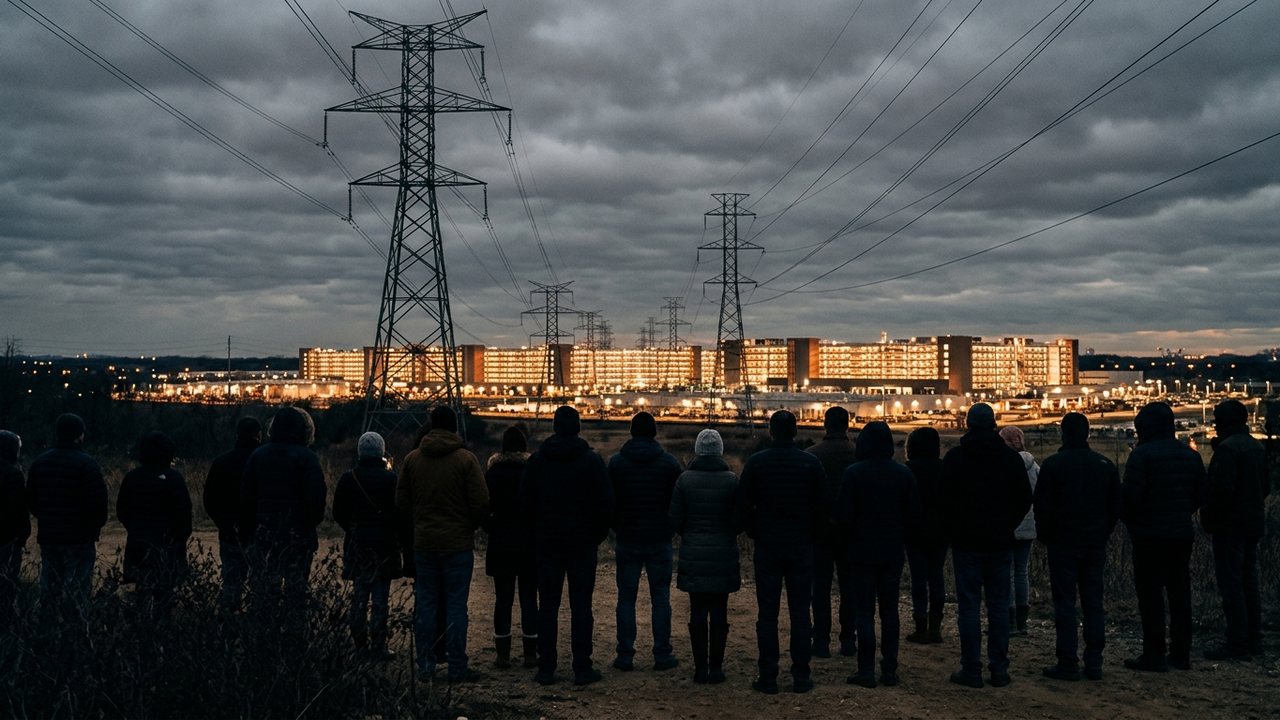
Every governor wants one, because they promise two things: jobs and taxes. Keep that promise in mind, because the rest of this story is about how little of the taxes actually shows up.
2. Big Tech Is Spending About $800 Billion This Year
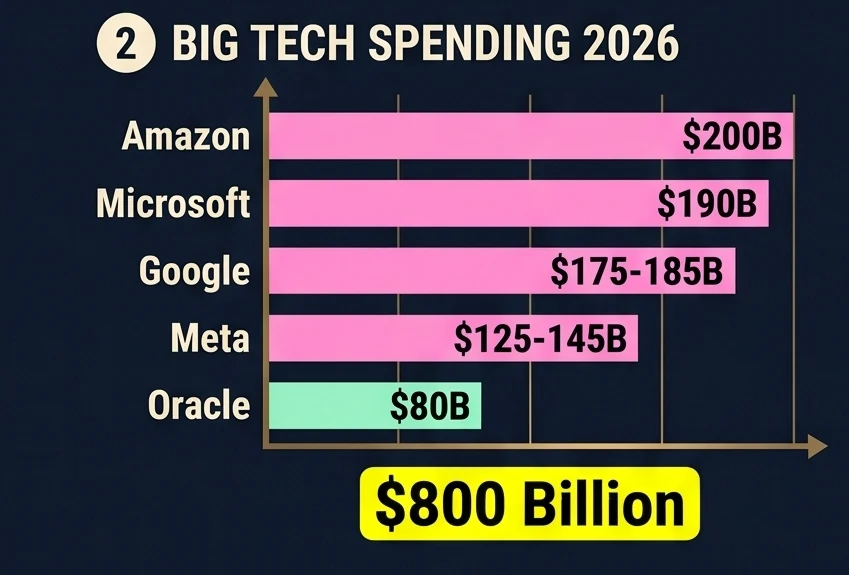
Amazon, Microsoft, Google, Meta and Oracle planned to spend about $800 billion in 2026 building these factories. That is one year. That money is a paycheck for the power companies, the builders and the chip makers, which is why every state wants a piece of it.
3. The States Are Paying to Win Them
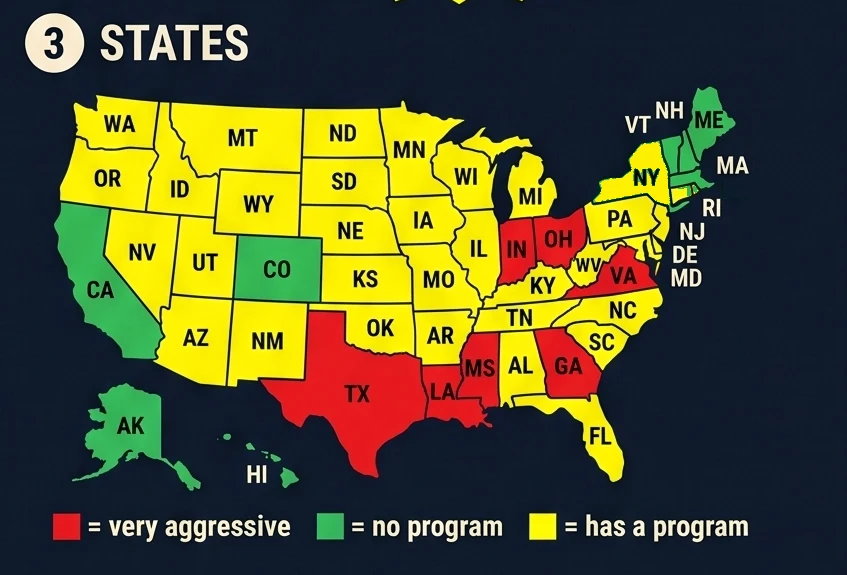
To get the projects, states started handing out tax breaks. 38 states now have special tax breaks for data centers (National Conference of State Legislatures).
- Red, the most aggressive: Texas, Louisiana, Mississippi, Georgia, Virginia, Indiana and Ohio.
- Green, no program: Alaska, Hawaii, California, Colorado and most of New England.
- Yellow: everybody else has some kind of program.
Georgia, Virginia and Texas each lose $1 billion or more every year to these breaks, according to Good Jobs First. Ohio paused its break this year.
4. Tax Break #1: No Sales Tax on the Chips
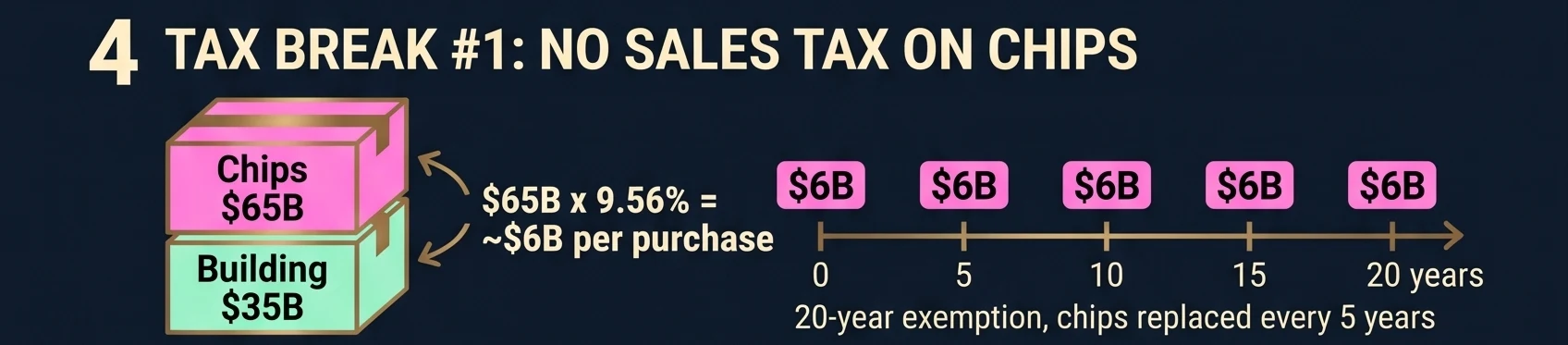
Take Meta's giant data center in Louisiana and say it costs $100 billion. About $65 billion of that is chips and $35 billion is the building.
If you or I buy something, we pay sales tax. At 9.56%, sales tax on $65 billion of chips is about $6 billion. Louisiana gave Meta a 20-year sales tax exemption instead.
And chips wear out. If Meta replaces them every 5 years, it buys them again in year 5, year 10, year 15 and year 20. Every one of those purchases is another $6 billion the state doesn't collect.
This is her simplified example. One study put Louisiana's loss on Meta's original, smaller plan at more than $3.3 billion, and the project has since grown to a reported $50 billion.

5. Tax Break #2: Property Tax Off for Promising Jobs
The more jobs a company promises, the bigger the property tax discount. In her example, 300 jobs gets 60% off and 500 jobs gets 80% off.
Property tax on $100 billion at 1.35% is $1.35 billion a year. Take 80% off and Meta saves about $1 billion every year. Meta's original Louisiana deal promised 500 jobs. That works out to about $2 million a year in tax savings for each job.
6. Tax Break #3: The Big Beautiful Bill's Write-Off
This is the big one, and it comes from Washington.
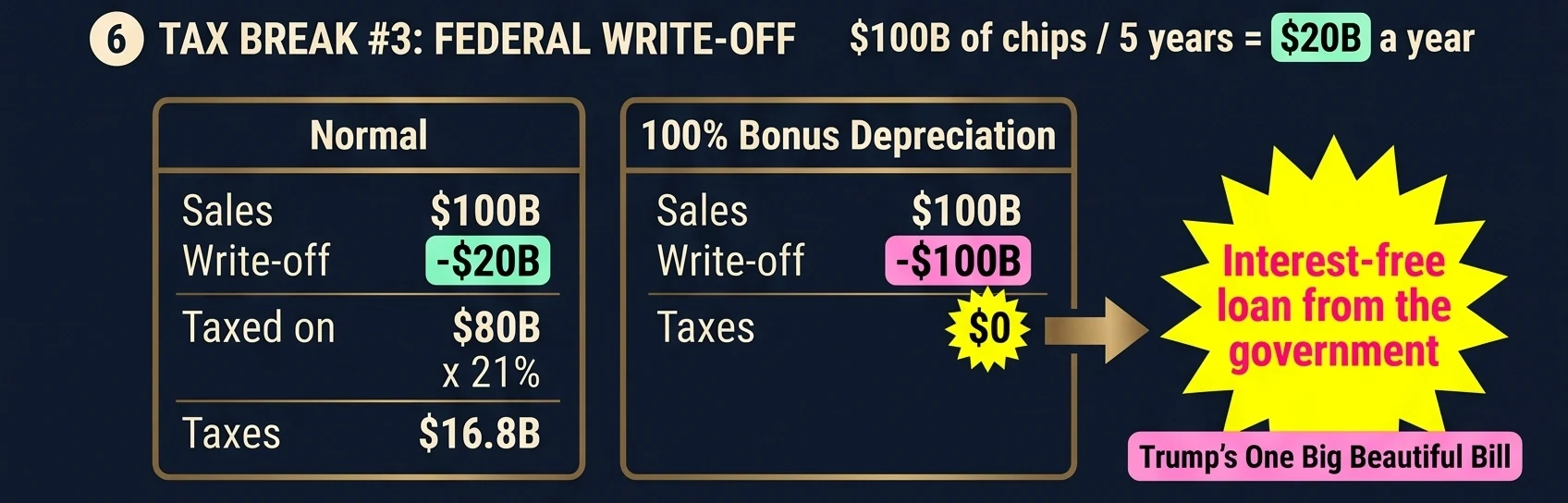
Chips last about 5 years. Normally a company that buys $100 billion of chips writes off $20 billion a year for 5 years. Say it has $100 billion in sales: subtract the $20 billion write-off and it's taxed on $80 billion. At the 21% corporate rate, it pays $16.8 billion in taxes that year.
Trump's One Big Beautiful Bill made 100% "bonus depreciation" permanent. Now the company writes off the whole $100 billion in year one. $100 billion in sales minus a $100 billion write-off is zero. It pays $0 in taxes.
It's not forgiven forever. With nothing left to write off in years 2 through 5, the taxes come back later. But putting off a $16.8 billion bill for years, with no interest, is an interest-free loan from the government. That's a big reason these companies are racing to build as fast as they possibly can.
Billion-Dollar Companies Get Breaks. Small Businesses Get the Bill.
This is the part that makes me angry. I own small businesses. I know what it takes to keep the doors open, and I can tell you nobody is handing small business owners deals like the ones above.
A write-off is only worth as much as you spend. A company spending $200 billion a year gets a $200 billion write-off up front. A small business buying one truck gets the write-off on one truck. No state offers a contractor, a restaurant or an insurance agency a 20-year sales tax holiday. No county gives the shop on Main Street 80% off its property tax for hiring people.
The small business owner pays full sales tax on every piece of equipment, full property tax on the building, and full price for the electricity that these data centers are pushing up. They're the ones who get up every day and fight to put food on the table, with everything stacked against them. Then, when a state gives billions away to Big Tech, the schools and roads still need paying for, and that bill lands on homeowners and small businesses.
My view: a lot of the AI profit story only works because taxpayers are carrying part of the cost. And the taxpayers carrying it are the same people trying to build something of their own.
What If That Money Went to Small Business Instead?
Look at the trade a state like Louisiana made. It gave up billions in future taxes. In return, the parish got a construction-season windfall, and teachers there got bonuses of up to $50,000 this year. I'm glad the teachers got paid. But a one-time windfall is not an economy.
Imagine if even a fraction of what states give away to data centers went to the people starting businesses in those same towns: help with startup costs, a break on equipment, a property tax break for opening a storefront. Small businesses create jobs that stay. They don't pack up when the building is finished.
That help doesn't come, and I think the reason is simple. The biggest companies have the lobbyists and the political donations, and small business owners don't. Big companies have no reason to push for help that would create new competition. So the breaks go up the ladder, and the risk stays at the bottom.
The same bill also ended the tax credits for new solar and wind projects that don't start building by July 4, 2026 or finish by the end of 2027. So the buildings that use the power got the break, and some of the ways to make the power lost theirs.
Voters Spoke, and Now AI Stocks Are Panicking
This is why people need to speak up, and on Election Day they did. Voters handed Congress to the Democrats, and in town after town they voted down new data centers. To me, that's a clear message to the Republicans who wrote these breaks into the Big Beautiful Bill: people are paying attention, and you don't get to load the bill onto taxpayers without consequences.
Democrats take control of Congress in January. The incoming Senate Finance chair, Ron Wyden, has already said his agenda is to tax billionaires and corporations: "affordability for us, accountability for them."
Now Do the Same Thing at Your Town Hall
Washington wrote the federal write-off, but the 20-year sales tax holidays and the property tax discounts get approved much closer to home: by county commissioners, parish boards and city councils. Those are the people who vote these deals through, and they're the ones you can actually reach.
And in some towns, people who show up to speak against data centers are getting thrown out by police:
- Claremore, Oklahoma: a farmer who spoke against a data center went a few seconds over his three-minute limit and was removed by officers, arrested and charged with trespassing, according to Tom's Hardware.
- Hobart, Indiana: video shows a man removed from a public meeting about a planned Amazon data center, and he was later arrested, Fox 32 Chicago reported.
A public meeting is where taxpayers are supposed to be heard. When a council calls the police on residents for speaking up about a deal that costs them billions, that tells you whose side those officials are on.
Voters made a stand at the federal level. Now it has to happen at the local level too. Find out who on your county commission or city council voted for these deals. Go to the meetings. And vote out the local officials who approve these giveaways and use the police to shut people up.
Two days after the election, the Nasdaq fell 5.5% and AI stocks led the drop (here's what happened on November 5). Bonus depreciation is "permanent" only until Congress changes the law. If a new Congress rolls back these breaks, the cost of every one of these AI factories goes up, and Wall Street knows it.
What It Means for You
- Your job: these projects create hundreds of permanent jobs, not thousands. The construction jobs are real, but they leave when it's built.
- Your taxes: when a state gives up billions, somebody else pays for the schools and roads. Usually that's homeowners and small businesses.
- Your business: the write-off works for you too, on a smaller scale. If you're buying a truck or equipment, ask your accountant about writing it all off this year, before Congress changes anything.
- What the town gets: the parish around Meta's Louisiana project collected $38.7 million in sales tax in the first three months of 2026, up from $5.3 million a year earlier, and teachers got bonuses of up to $50,000. Most of that comes during construction. The tax breaks last 20 years.
If it's such a good business, it shouldn't need taxpayers to carry it. And if taxpayers are carrying it, they should get a piece of the company, not just a construction boom.
Watch @thewallstreetskinny draw it out:
Watch @thewallstreetskinny's breakdown on Instagram
- @thewallstreetskinny on Instagram: The Finance of AI
- Stateline: Many states don't report losses from data center tax breaks (Good Jobs First, NCSL)
- Ohio, Arizona and Illinois pause data center sales tax exemptions
- Louisiana Illuminator: Meta plans $10B data center with 500 jobs
- Fortune: Meta's Hyperion tax break in Louisiana
- KTBS: Study says Louisiana may be giving up billions for Meta data center
- The Next Web: Meta's Hyperion data centre hit $50bn
- GovTech: Data center tax revenues yield $50K bonuses for Louisiana teachers
- IRS: First-year depreciation under the One Big Beautiful Bill
- Pierce Atwood: Congress phases out energy tax credits
- The Hill: Wyden reveals Senate Finance Democrats' agenda
- Tom's Hardware: Oklahoma farmer arrested at AI data center town hall
- Fox 32 Chicago: Man removed, arrested at Indiana data center meeting
- NPR: Stock markets, AI and the midterm elections